
Posted by Isabel on Jul 14th 2026
Fleur de Sel vs. Sel Gris: Which One Should You Buy?
Buying Guide
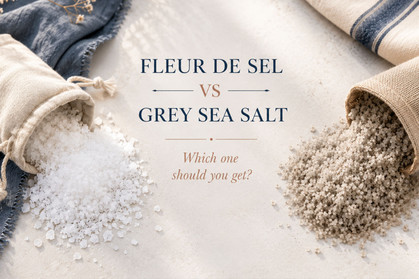
Fleur de Sel vs. Sel Gris: Which One Should You Buy?
Same marshes, same paludiers, two completely different jobs in your kitchen. Here's how to tell them apart and which one you actually need.
I get this question a lot: someone's about to buy their first bag of French sea salt and they don't know if they want fleur de sel or sel gris. Both come from the same place, the same marshes in Guérande, Brittany, and both are hand-harvested by the same paludiers. But they're not interchangeable, and buying the wrong one for the job means either wasting a $20 finishing salt in a soup pot, or reaching for a coarse cooking salt when you needed something delicate.
I visited the Guérande salt marshes myself a few years ago, and it's one of those places that changes how you think about an ingredient you've used your whole life. Everything is still made the way it was 500 years ago. No machines, no shortcuts. Just wooden rakes, sun, wind, and paludiers who know the water well enough to read it. There's a real respect there for the land and the tide, for taking only what the marsh gives that day and nothing more. You taste that when you use the salt.
Same marsh, same hands, two different salts. The only real question is what you're putting them on.
What's Actually the Difference?
The difference isn't quality. It's where in the pond each salt forms, and how it's harvested.
Fleur de sel, "flower of salt," forms as a thin, fragile crust on the surface of the water. It's skimmed by hand with a shallow wooden rake called a lousse, and it can't be harvested by machine without breaking the crystal. This is why it's more expensive, and why it's always sold as a finishing salt, never a cooking salt.
Sel gris, grey salt, settles on the clay floor of the pond instead of the surface. It's drawn to the edge with a longer rake, the las. It picks up trace minerals from the clay as it sits there, which is what gives it that grey color and slightly damp texture. Nothing is added and nothing is washed out.
One floats and gets skimmed. One sinks and gets raked. That's really the whole story.
Fleur de Sel: For Finishing, Never Cooking
Fleur de sel goes on at the very end. Not in the pot, not in the batter, not while something's still cooking. You sprinkle it on right before serving, and the crystals stay mostly whole, giving you that little bit of crunch and a clean, slightly sweet minerality instead of just salty.
This is the salt I use to finish a seared steak, sliced tomatoes in summer, or a dessert like the chocolate lava cake, where a single pinch on top of the warm cake does more for the flavor than another ingredient in the batter ever could. If you cook with it, you're wasting it. Save it for the moment right before the food hits the table.
We carry it two ways: the everyday kitchen bag for the counter, and the linen bag, which is the one I'd actually leave out on the table if people are watching you cook.
If you already know you're a fleur de sel person, or you're buying this as a gift, the fleur de sel trio is worth a look. It's three small jars: plain fleur de sel, one infused with Espelette chili, and one with Kampot pepper. The plain one covers everything I mentioned above. The two flavored ones are their own thing entirely, closer to a finishing spice than a salt, and they're the kind of gift that makes someone rethink what salt is even for.
Sel Gris: For Everyday Cooking
Sel gris is the workhorse. It comes in two grinds, and each one has a different job.
Fine grey salt is what I use for most everyday cooking: pasta water, vinaigrettes, bread dough, and seasoning meat right before it hits the pan. It's what I reach for when I make steak au poivre: a generous seasoning of fine grey salt just before the steak goes in the pan, so it can do its job during the sear.
Coarse grey salt is for when time is on your side. I like using it to season meat well ahead of cooking, about 45 minutes before it hits the pan or grill. The coarser crystals draw moisture out slowly and then get reabsorbed, seasoning the meat all the way through instead of just on the surface. It's also what you want for a salt crust on a whole fish, for brines, or for roasted vegetables where you want the salt to actually cook into the dish. The coarse sea salt is the one to keep next to the stove.
So, Which One Should You Buy?
If you only buy one: get the fine grey salt. It's the one you'll use every day, for everything.
If you cook a lot of meat or fish and like to season ahead: add the coarse salt.
If you want the one that makes people ask what it is: that's fleur de sel. It's the finishing touch, not the daily driver.
The French Way of Doing It
What stayed with me most from that visit to Guérande wasn't the salt itself, it was the pace. Paludiers walk the same ponds their families have worked for generations, and they take exactly what the marsh gives them that day. No more. There's a real respect for the water, the clay, the tide. Nothing rushed, nothing forced.
That's the part worth keeping in mind at home too. Sel gris for the everyday work, fleur de sel for the moment that deserves a little more attention. Neither one is better. They're just doing different jobs, the same way they have for 500 years.
Shop the Full Le Guérandais Collection
Fleur de sel, fine and coarse sel gris, and a flavored trio — all hand-harvested from the same marshes in Brittany, exactly as the tide leaves them.
Shop Le Guérandais SaltsIsabel is the founder of My French Recipe, a French cooking school in Plano, Texas, and a French pantry shop stocked with products she actually uses at home. Learn more about our story →