Jun 5th 2026
The Best Crepe Pan: Why a Carbon Steel Crepe Pan Wins Every Time (2026)
The Best Crepe Pan: Why a Carbon Steel Crepe Pan Wins Every Time (2026)
We cooked around 40 crepes across four pan types over a weekend. Here is what we found.

Most people make their first crepes in whatever pan they already own. A regular non-stick from the cabinet, maybe a stainless skillet. It works well enough once or twice — and then they start wondering why the crepes keep tearing, or sticking in spots, or cooking unevenly.
The pan is almost always the reason. Crepe batter is thin, the cooking window is short, and you need to flip something delicate quickly. A pan designed for something else is fighting you from the start.
We tested this properly: roughly 40 crepes across four pan types over a weekend at our cooking school in Plano — non-stick coated, cast iron, stainless, and carbon steel. We looked at heat consistency, how easy it was to flip without tearing, and how the pans performed as they warmed up through a full batch. Carbon steel won clearly. Here is why.
| ✓ Best overall for home crepe-making |
| ✓ Made in France since 1830 |
| ✓ Gets more nonstick with every use |
| ✓ Works on all stovetops including induction |
| ✓ In stock · Ships from Plano, TX · Free shipping over $69 |
What actually matters in a crepe pan
A crepe pan is not just a small frying pan. There are a few things that separate a pan built for crepes from one that technically works but makes the job harder than it needs to be.
Low, sloped sidesThis is the most important design feature. A crepe pan has sides that slope out to less than an inch, so you can slide a spatula cleanly underneath without catching or tearing. A regular high-sided skillet makes this frustrating. |
Even heat distributionCrepe batter is thin and cooks quickly. If the pan has hot spots, parts of the crepe overcook while others are still raw. You need a material that spreads heat smoothly across the whole surface, not just in the center over the burner. |
The right weightYou need to tilt and swirl the pan to spread batter before it sets. A pan that is too heavy makes this awkward. Cast iron typically runs 5 to 6 lbs. Carbon steel crepe pans come in around 2.5 lbs — light enough to swirl one-handed through a full batch. |
A surface that releases wellCrepes stick badly to stainless steel. Non-stick coatings help but degrade over time and cannot handle the heat a good crepe needs. Carbon steel builds a natural, permanent nonstick surface through use that only gets better. |
How the main pan types stack up
Here is how each pan type performed across our testing.
Works fine for the first year or two. The coating releases well, cleanup is easy, and the learning curve is gentle. But non-stick coatings degrade from high heat and everyday use. Once the coating starts to go, the pan sticks worse than anything else. You end up replacing it every couple of years — which costs more over time than a carbon steel pan that lasts decades.
Great nonstick surface, lasts forever, holds heat beautifully. For crepes, the weight is the problem. A cast iron crepe pan typically weighs 5 to 6 lbs. Swirling that in a circle to spread thin batter quickly, before it sets, is genuinely tiring. It also takes a long time to heat up, which slows you down when making a large batch.
Excellent for searing and deglazing. A poor choice for crepes. The batter sticks badly unless the pan is extremely hot and very well oiled, and even then you are fighting it. Skip it for this purpose.
Carbon steel sits in the sweet spot between cast iron and non-stick. It heats fast and evenly, develops a natural nonstick surface through use, handles high heat without any issues, and is light enough to swirl easily. A carbon steel pan that is properly cared for lasts decades. The more you cook with it, the better it works — the opposite of a coating that wears out.
De Buyer Blue Carbon Steel Crepe Pan 9.5" — reviewed

De Buyer has been making cookware in the Vosges mountains of France since 1830. They supply professional kitchens all over the world. The Blue Carbon Steel line is their entry-level range — which, in De Buyer terms, still means professional-grade materials and French craftsmanship.
The pan is 9.5 inches across — the right size for a classic French crepe. The long steel handle gives good leverage and control, and at 2.5 lbs you can tilt and swirl it one-handed through a full batch without straining.
The blue finishThe distinctive blue color comes from a heat treatment applied to the steel before it leaves the factory. It helps prevent rust and gives the seasoning process a head start compared to raw carbon steel. |
The patinaAfter a few months of regular use, the pan turns dark and develops a deep, almost black surface — layers of polymerized oil baked into the steel. Completely natural, completely food-safe, and the reason the pan becomes more nonstick the longer you own it. |
Made in FranceNot assembled in France or designed in France — made in France. The steel comes from French mills and the pans are shaped in the De Buyer factory in the Val d'Ajol. That matters for quality consistency and for anyone who cares about buying things built to last. |
Any stovetop, oven tooWorks on gas, electric, ceramic, and induction. Oven-safe up to 400 degrees F for up to 10 minutes — useful if you want to keep a batch warm while you finish cooking the rest. |
Pan specs & availability
| Material | 99% iron, 1% carbon |
| Diameter | 9.5 inches |
| Cooking surface | 5 inches |
| Thickness | 2 mm |
| Weight | 2.5 lbs |
| Oven safe | Up to 400 degrees F (up to 10 min) |
| Made in | France |
| Price | $40 |
| Availability | In stock |
| Shipping | Ships from Plano, TX · Free over $69 |
How to season and care for your carbon steel pan
Carbon steel needs a little attention when it is new. The seasoning process takes about 10 minutes and you only have to do the full version once. After that, the pan takes care of itself as long as you follow a few simple rules.
First wash. Rinse the pan with hot water and a soft sponge. No soap. Dry it thoroughly — either with a towel or by putting it over low heat for a minute.
Season with oil. Heat the pan over medium heat. Add a very thin layer of grapeseed or avocado oil — just a few drops, rubbed around with a paper towel. Heat until the oil just starts to smoke lightly, then let it cool.
After each use. Rinse with hot water while still warm. Wipe dry. Rub lightly with oil before storing. Never put it in the dishwasher and avoid soap — both strip the seasoning you have built up.
Two more tools that make crepes easier
The pan does most of the work, but these two pieces from the De Buyer B BOIS collection round out a proper crepe setup. Both handcrafted in France.

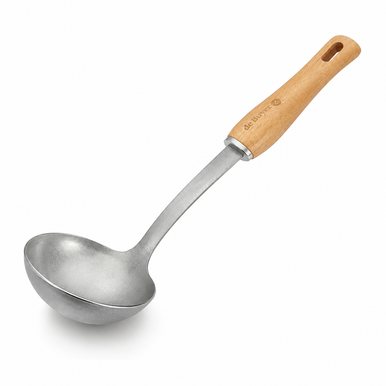
The turner and ladle are not optional extras
Most tearing and sticking problems come down to two moments: getting the spatula under the crepe to flip it, and getting a consistent amount of batter into the pan each time.
A regular kitchen spatula is too thick and stiff to slide cleanly under a thin crepe. You end up prying instead of gliding, which pulls the crepe and tears it at the edges. The De Buyer flexible turner has a very thin blade that bends slightly as it goes under the crepe. It slides in without catching, which means clean flips every time — even on your first few tries.
The ladle is about consistency. Too much batter and the crepe is thick and chewy. Too little and it tears when you try to lift it. Using the same ladle every time means every crepe in the stack comes out the same thickness — which matters both for how they cook and how they look on the plate.
The best first recipe for a new carbon steel pan
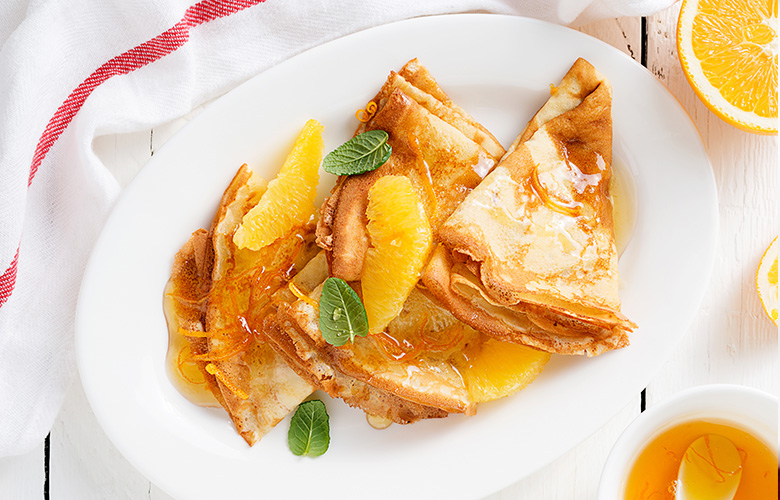
Once the pan is seasoned, the best thing you can make first is Crepes Suzette. It is the most famous French crepe recipe for a reason — and it is a great way to break in a new pan, because it involves making a large batch all the way through.
Orange butter, a little Grand Marnier, and crepes that are thin and golden. The recipe is easier than it looks.
See the Crepes Suzette recipe →Crepe pan FAQ
What size crepe pan do I need?
9.5 inches is the standard size for a classic French crepe. It is large enough to make a real portion but small enough to spread batter quickly before it sets. If you are cooking for large groups regularly, a 12-inch pan gives you more room to work, but the 9.5 inch handles most home situations comfortably.
Is carbon steel better than non-stick for crepes?
Yes, in the long run. Non-stick is easier from day one, but the coating degrades over time — especially with the high heat crepes need. Carbon steel gets more nonstick the more you use it, handles any heat level without issue, and lasts decades with basic care. It takes a session or two to season properly, but after that it outperforms non-stick by a wide margin.
Can I use a carbon steel pan on any stovetop?
Yes. The De Buyer Blue Carbon Steel pan works on gas, electric, ceramic, and induction. It is also oven-safe up to 400 degrees F for up to 10 minutes, which is useful if you want to keep a batch of crepes warm while you finish cooking the rest.
My pan is rusty. Is it ruined?
No. Surface rust on a carbon steel pan is easy to fix. Scrub the rust with coarse salt and a little oil using a paper towel. Rinse with hot water, dry completely on the stove over low heat, then re-season with a thin layer of oil. The pan is fine. Rust means moisture got to it — keep it dry after washing and it will not happen again.
What is the difference between the De Buyer Blue and the Mineral B?
Both are carbon steel and made in France. The main difference is the initial treatment. The Mineral B comes with a beeswax coating from the factory, which makes seasoning easier right out of the box and gives slightly more rust resistance from day one. The Blue Carbon Steel has a heat-treated blue finish that also helps, just without the beeswax. For most home cooks, the Blue is the better value — same performance, same French craftsmanship, lower price.
Where can I buy a De Buyer crepe pan?
You can get it right here at My French Recipe for $40, with free shipping on orders over $69. It is also available through De Buyer USA and Amazon. That said, buying from us means supporting a small French cooking school in Plano, Texas — and we are happy to answer any questions about the pan before you buy.
Can I cook things other than crepes in it?
Absolutely. Once it is fully seasoned, it works as a general-purpose flat pan for everyday cooking — eggs, pancakes, tortillas, thin omelettes, sauteed vegetables. Some people end up using theirs more for eggs than for crepes.